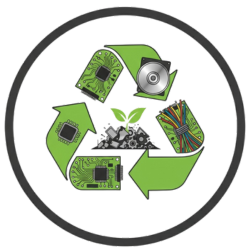
A Dubai company upgrades its computers and replaces old servers. Soon, a storage room is full of outdated electronics. Nobody knows what to do with them.
E-waste recycling in Dubai means collecting old electronics, destroying any stored data, then dismantling devices to recover metals, plastics, and glass. Businesses should never throw electronics in general waste. Use a licensed, Dubai Municipality-approved recycler, ask for secure data destruction, and keep your Certificate of Recycling.
What Is E-Waste?
E-waste, or electronic waste, is any electrical or electronic equipment at the end of its useful life. It can be working, repairable or completely obsolete. In Europe, it’s called WEEE (waste electrical and electronic equipment). See the full range of IT scrap services for Dubai businesses.
Common Types of E-Waste
| Category | Examples | Holds data? |
| Computing and office hardware | Desktop PCs, laptops, monitors, docking stations, printers | Yes |
| Enterprise and networking | Rack servers, routers, switches, firewalls, UPS units | Yes |
| Mobile and communication | Smartphones, tablets, VoIP desk phones | Yes |
| Digital storage media | HDDs, SSDs, backup tapes, USB drives | Yes |
| Parts and accessories | Circuit boards, motherboards, cables, chargers, batteries | Sometimes |
What Is Inside Electronics?
Electronics contain valuable materials like gold, silver, copper, aluminium, lithium, and rare earth elements. They also contain hazardous substances like lead, mercury and cadmium.
Why E-Waste Recycling Matters in Dubai
Protecting the Environment
When e-waste is thrown away badly, heavy metals can leach into soil and groundwater. This harms people, animals and ecosystems.
Protecting Your Data
Old laptops, printers and servers often hold customer data, financial records and intellectual property. Formatting or deleting files does not permanently erase data.
Recovering Valuable Resources
Recycling recovers metals for manufacturing, using less energy than mining new ones.
Supporting Dubai’s Sustainability Goals
E-waste recycling supports Dubai’s Green Economy Initiative and the UAE’s Net Zero by 2050 goal. It also saves landfill space as Dubai’s population grows.
The E-Waste Recycling Process (Step by Step)
Step 1: Inventory Your Assets
List every device with its make, model, quantity, and serial number. Flag anything that stores data.
Step 2: Choose a Licensed Recycler
Never hand e-waste to informal scrap dealers. Choose a licensed, Dubai Municipality-approved company.
Step 3: Confirm Scope and Quotation
Agree on what can be bought back, what will be recycled, and how storage will be treated. Get it in writing.
Step 4: Secure Collection
Book pickup from your office, warehouse, or data centre. Check loading-bay hours and access permits. Keep a chain-of-custody record.
Step 5: Data Destruction
Storage is wiped or physically shredded before any recycling. A factory reset is not a substitute.
Step 6: Dismantling and Sorting
Trained workers remove batteries and hazardous parts first. Devices are then broken down into metals, plastics, glass, and circuit boards.
Step 7: Material Recovery
Materials are separated by magnetic separation, air classification, and water-based sorting, then refined for reuse.
Step 8: Certificates and Records
You receive a Certificate of Recycling and, where agreed, a Certificate of Destruction.
Dubai E-Waste Laws and Government Initiatives
Federal Law No. 12 of 2018
This UAE law on Integrated Waste Management covers waste handling, including hazardous waste. Cabinet Decision No. 39 of 2021 is its implementing regulation.
Dubai Municipality Rules
Dubai Municipality sets local rules for e-waste collection, transport, and disposal, and runs awareness campaigns.
Recycling Facilities and Collection Drives
Enviroserve, now part of DH Investments and Tadweer Group, runs a 240,000 sq ft facility in Dubai, described as the largest in the MEA region. Retail drives, like the Sharaf DG National E-waste Collection Drive, also let residents donate old devices.
Secure Data Destruction and Certificates
Wiping or Destruction
Storage can be wiped with NIST SP 800- 88-aligned sanitisation when reuse makes sense. Media that must not return to service should be physically destroyed.
On-Site Shredding
If readable disks must not leave your building, book on-site hard drive shredding.
What Certificates Cover
A Certificate of Data Destruction covers the media that was wiped or destroyed. A Certificate of Recycling confirms responsible disposal. Both support audits and ESG reports.
E-Waste Recycling vs IT Asset Disposal
E-Waste Recycling
This is dismantling for equipment that won’t be used again.
IT Asset Disposal (ITAD)
ITAD is wider. It covers collection, data handling, buyback where value exists, and recycling for the rest.
Can You Turn E-Waste Into Cash in Dubai?
Yes. Not all e-waste is waste. Many old devices still have real value.
What You Can Sell
Working laptops, phones, servers, and networking gear can often be bought back for reuse. Even broken devices hold value in their metals, circuit boards, and parts.
What Affects the Price
Buyers look at the type, condition, age, and quantity of your equipment. Bulk lots and working devices usually get better offers. Scrap is priced by material value.
Sell First, then Recycle
The smart approach is simple. Sell items that still have a market. Recycle only what can’t be reused. One collection can cover both.
Benefits of E-Waste Recycling
- Environmental protection: less pollution and landfill waste
- Data security: no sensitive data left on old devices
- Extra income: cash for devices that still have value
- Compliance: aligned with UAE environmental standards
Tips for Responsible E-Waste Disposal
For Businesses
Document your e-waste, partner with a licensed recycler, and train staff.
For Residents
Use Dubai Municipality bins or retailer take-back programmes. Wipe your data first, and donate working electronics to schools or charities.
Responsible E-Waste Recycling Across the UAE with IT Scrap Dealer
IT Scrap Dealer connects Dubai businesses and individuals with licensed, verified buyers. Share your equipment list, get matched with a buyer and receive a competitive offer.
Collection is free across all seven emirates, from Dubai and Sharjah to Abu Dhabi, Ajman and Ras Al Khaimah. Data wiping or physical destruction is arranged for storage devices, and equipment that can’t be reused is recycled responsibly. We help offices, schools, warehouses and data centres.
Send your equipment list on WhatsApp at +971 55 517 1646 (available 24/7), or visit our IT Scrap Buyer in Dubai page. Learn more at IT Scrap Dealer.
Conclusion
E-waste recycling in Dubai protects the environment, keeps your data safe and recovers valuable resources. List your devices, choose a licensed recycler, destroy all data and keep your certificates. Do this, and you’ll clear old electronics responsibly and with complete peace of mind.
FAQs
What counts as e-waste?
Computers, laptops, servers, printers, monitors, phones, cables, circuit boards, and other electrical equipment.
Is e-waste recycling safe for my data?
Yes, if the recycler wipes or destroys storage before processing.
What happens to e-waste after collection?
Data is destroyed, devices are dismantled, and materials are recovered for reuse.
